A correspondence as dossier
The letters on the desk
Psychoid · 1932–1958 · Zürich, Princeton, letters
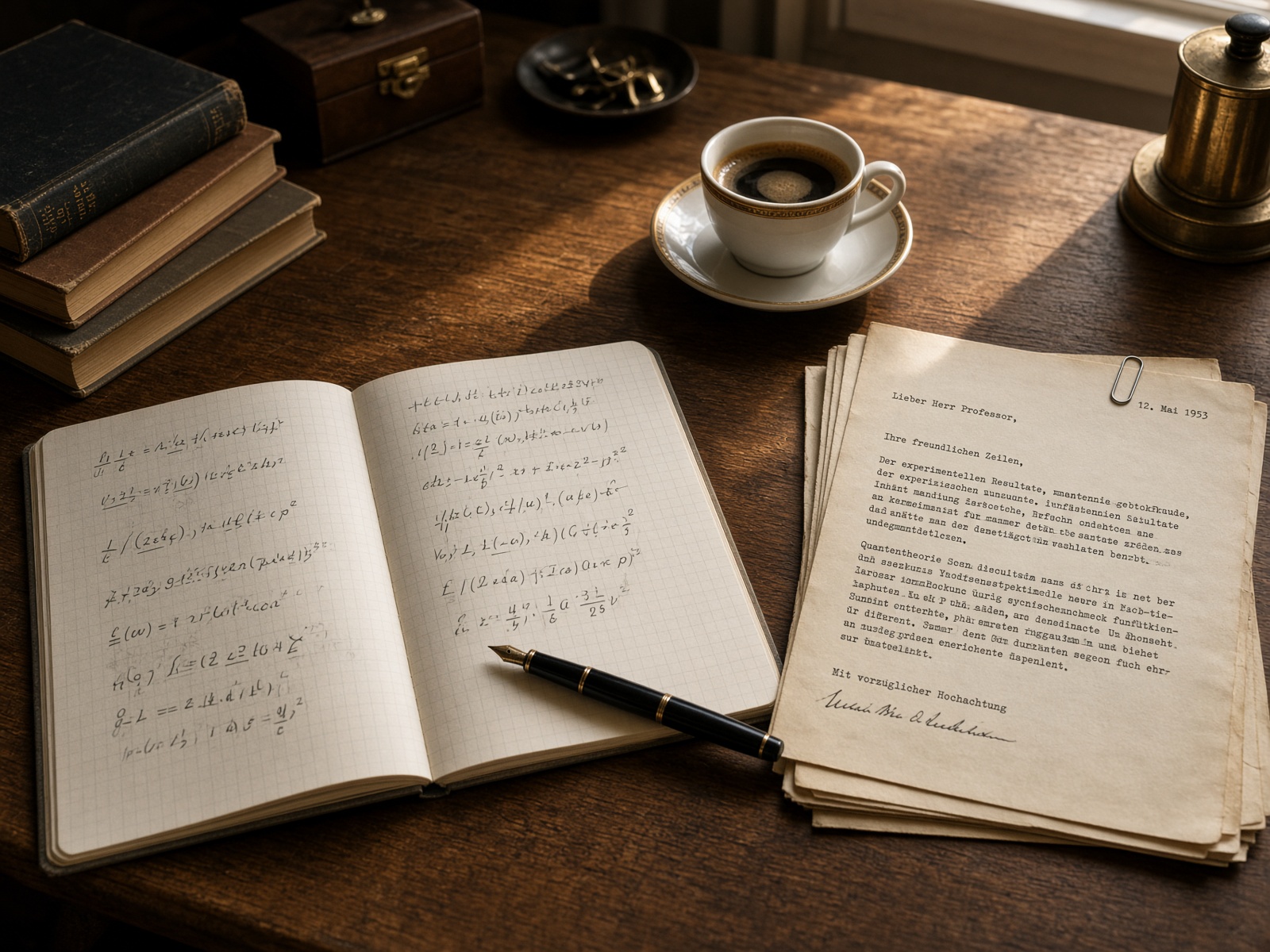
The letters are many. This page is a desk, not one night.
Wolfgang Pauli came to Jung as a patient in the early 1930s and remained a correspondent until Pauli’s death in 1958. The published letters are a dossier: dreams, numbers, diagrams, disagreements, revisions. Twenty-five years are not one scene. Specific episodes live in other rooms: the laboratory superstition, the day of the fishes, the beetle. Here the object is the correspondence itself.
Sourced
The letters are documentary. The theories they contain are not, by that fact, demonstrated. Physics is allowed to remain physics.
Speculation
Later readers have treated the correspondence as proof of a hidden field. The letters do not carry that proof. They carry a difficulty.
The psychoid is a theoretical border concept, not a demonstrated hidden mechanism connecting events.
Jung needed a word for a level that could not be described as simply psychic in the ordinary sense. That need is historically interesting. It is not an empirical finding.
Concordance
- The thing
- A long correspondence in which synchronicity, number, and the psyche/matter border were argued, revised, and left unfinished.
- Seen
- Letters exist. They have been published. Dates, diagrams, disagreements are in the record.
- Sourced
- Atom and Archetype: The Pauli/Jung Letters, 1932–1958. Synchronicity as a term enters their usage in the late 1940s.
- Miss
- Neither man established a mechanism. Pauli remained a physicist. Jung remained a psychologist. The psychoid stayed a border concept.
- One question remains
- What conceptual problem required a word that was not simply ‘psyche’?