English / Latin · imago
image
What appears. Before it is asked to mean.
Because THE FIELD asks the reader to remain with what appears before turning appearance into symbolic shorthand.
Association
What arises in me. Marked as mine.
Symbol?
Only if the image is still unfinished, and only in one office of that word.
Interpretation?
A reading. Several can live. None eat the plate.
Latin
imago
likeness · copy · statue · shade · ancestral mask
Latin imago: copy, likeness, statue, shade, ancestral mask. Lewis and Short give that range. English image kept the likeness. That English often lost the ghost is this house’s reading of the history, not a dictionary’s claim.1
James Hillman asked psychology to stay with the image rather than translate it at once into a concept. That is his method in Re-Visioning Psychology. THE FIELD’s practice is inspired by that remaining. It is not identical with it.2
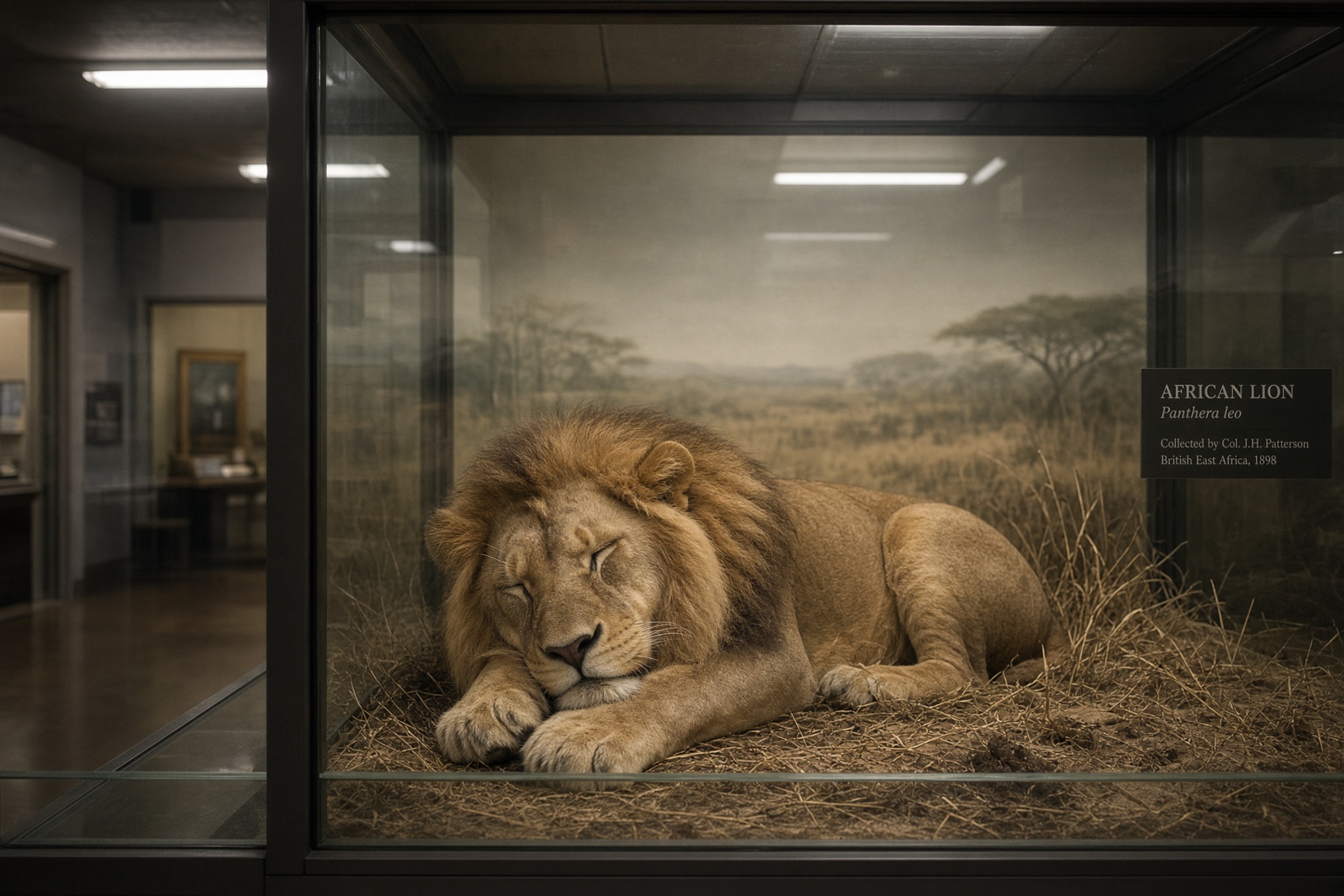
A dream figure, a painting, a beetle, a lion behind glass, a memory’s reconstruction. Not automatically a symbol, not automatically a message.
Misuse
Snake equals transformation. House equals self. Water equals emotion. Those substitutions are not always false as associations. They are false as replacements. Which snake? Which house? Which water? What did it do, where was it, what was the affect, what belongs to this life?
Snake = transformation. House = self. Water = emotions. An image is not a problem waiting to become prose.
Which image? What did it do?
Notes
- Charlton T. Lewis and Charles Short, A Latin Dictionary (Oxford: Clarendon Press, 1879), s.v. imago.
- James Hillman, Re-Visioning Psychology (New York: Harper & Row, 1975).